
When an unexpected brake repair, pediatric dental copay, or electric shutoff notice arrives five days before direct deposit clears, storefront signage and online cash-advance portals rarely advertise an annualized interest rate in headline type. Instead, short-term credit offers quote a flat dollar fee per hundred dollars borrowed—most commonly $15 per $100. Framed as fifteen cents on the dollar, a $60 charge to bridge a $400 checking gap until Friday week after next feels intuitive and contained, much like an ATM surcharge or expedited shipping fee.
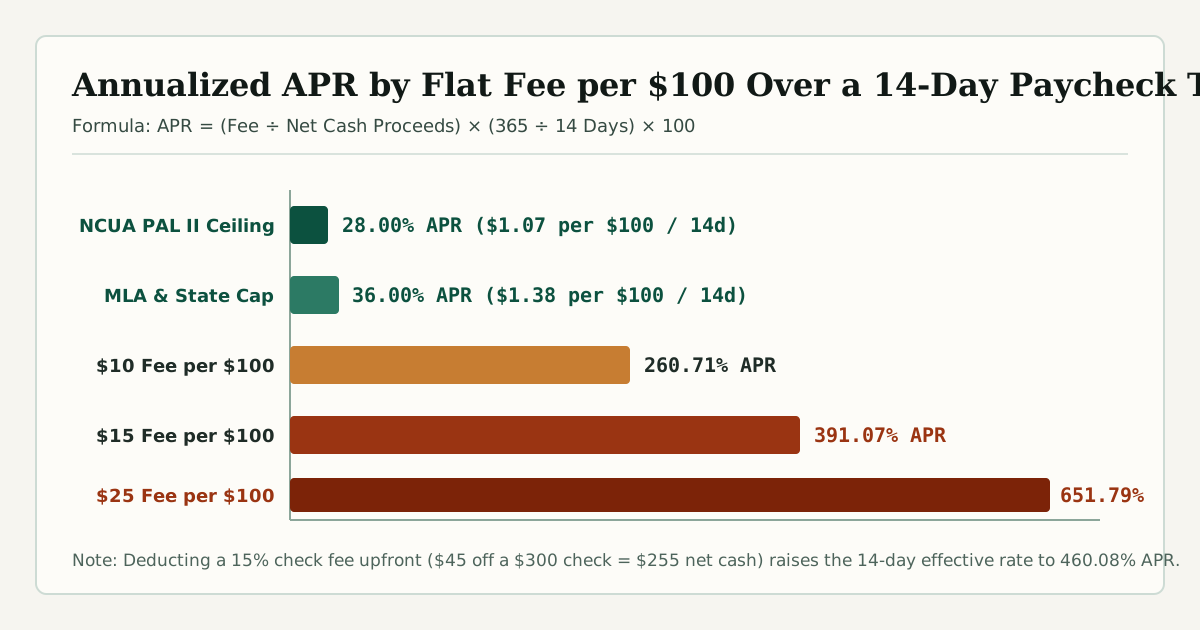
Yet federal Truth in Lending Act (Regulation Z, 12 CFR § 1026.22) disclosures require lenders to translate that flat dollar fee into an Annual Percentage Rate (APR) for a practical household reason: APR measures the price of renting money per unit of time. Once you account for the fact that you only get to keep the $400 for fourteen calendar days rather than twelve months, that seemingly modest $15-per-$100 charge equals 391.07% APR. Understanding the exact arithmetic behind short-term fee quotes protects your next paycheck from hidden cost escalation before you sign an ACH debit authorization.
The Exact Four-Step Formula Behind Single-Payment APR
Unlike a thirty-year mortgage or a five-year auto note where principal amortizes downward each month, a classic online or storefront payday advance is a single-payment balloon contract. You receive cash proceeds today, make zero intermediate payments, and authorize the lender to debit both the entire principal and the flat finance charge on your upcoming payday. Because no principal is paid down mid-term, the nominal single-period APR formula under Regulation Z Appendix J reduces to four straightforward operations:
- Isolate Net Cash Proceeds (Amount Financed): Count only the actual spendable dollars deposited into your checking account or handed to you at the counter, subtracting any origination, verification, or check-holding fee withheld upfront.
- Divide Finance Charge by Net Proceeds: Compute the periodic cost ratio for your single borrowing window (
Periodic Rate = Total Fees ÷ Net Cash Received). - Count Exact Calendar Days to Maturity: Measure the exact number of days from disbursement to the scheduled payroll debit—typically 7 days for weekly earners, 14 days for biweekly payroll, or 15 to 30 days for semi-monthly and Social Security schedules.
- Annualize by Pay Periods per Year: Multiply the periodic cost ratio by
365 ÷ Term in Daysand multiply by 100 to express the figure as a percentage.
Applying those four steps to a $400 advance carrying a $60 fee due in 14 days yields:
Periodic Rate = $60 ÷ $400 = 0.15 (15.00% for 14 days)
Pay Cycles per Year = 365 ÷ 14 = 26.0714 cycles
Annual Percentage Rate = 0.15 × 26.0714 × 100 = 391.07% APR
You can test your own paycheck interval and fee quote instantly using the Interactive True-APR & Rollover Calculator on our home almanac sheet.
Why Paycheck Timing Swings Effective APR More Than Borrowers Expect
Because the flat dollar fee on a short-term advance rarely drops when your payday arrives sooner than two weeks away, borrowing mid-cycle dramatically inflates the annualized price of funds. Suppose a borrower paid every Friday takes out a $300 advance with a flat $45 fee on a Monday, with repayment scheduled for that Friday—just four calendar days later—or the following Tuesday—eight calendar days later. Even though the dollar fee stays fixed at $45, the time value of the credit collapses:
| Payroll Schedule Scenario ($400 Net Cash, $60 Flat Fee) | Days Held | Periodic Cost | Daily Dollar Cost | Truth-in-Lending APR |
|---|---|---|---|---|
| Emergency mid-week bridge to Friday paycheck | 7 days | 15.00% | $8.57 / day | 782.14% APR |
| Ten-day bridge across a biweekly pay gap | 10 days | 15.00% | $6.00 / day | 547.50% APR |
| Standard two-week biweekly pay cycle | 14 days | 15.00% | $4.29 / day | 391.07% APR |
| Monthly pension or Social Security cycle | 30 days | 15.00% | $2.00 / day | 182.50% APR |
| NCUA Federal Credit Union PAL II (28% statutory cap) | 14 days | 1.07% | $0.31 / day | 28.00% APR |
Notice the daily dollar column: renting $400 for seven days at a $60 flat fee costs $8.57 every single day, compared with thirty-one cents per day under a regulated 28% Federal Credit Union Payday Alternative Loan (compare full PAL I and PAL II rules).
The Face-Value Deduction Trap: Why a 15% Check Cap Can Equal 460% APR
Several state deferred-deposit statutes—most notably California under the California Deferred Deposit Transaction Law (Cal. Fin. Code § 23036)—cap the maximum fee at 15% of the face amount of the borrower's check up to a $300 maximum check size, rather than 15% of the cash handed to the consumer. That wording difference creates an expensive denominator shift.
Worked Check-Deduction Arithmetic
When you sign a deferred-deposit agreement for the statutory $300 maximum in a check-deduction jurisdiction, the lender withholds the 15% fee ($45) immediately and hands you $255.00 in usable cash. Fourteen days later, the lender deposits your $300 check. Under Truth in Lending rules, your Amount Financed is $255, not $300:
- True Periodic Fee Ratio:
$45 ÷ $255 = 17.647%(nearly three percentage points higher than the advertised 15% check cap). - 14-Day Annualized APR:
0.17647 × (365 ÷ 14) × 100 = 460.08% APR. - Shortfall Consequence: If your auto-repair invoice is $300, walking out with $255 leaves you $45 short—tempting households to stack a second fee-bearing app advance on the very same afternoon.
Stacking Instant-Transfer & Verification Fees Onto Online Advances
Online lenders and earned-wage cash apps frequently unbundle pricing into separate line items that obscure the real finance cost. Before clicking accept on a same-day disbursement screen, audit three fee categories that often bypass headline quotes:
1. Debit-Card Push & Expedited Rail Surcharges
While standard Automated Clearing House (ACH) credit transfers cost pennies for lenders to originate, many online portals default borrowers into an "Instant Debit Card Funding" toggle carrying a $5.99 to $14.99 expedite surcharge. Adding a $9.99 instant-delivery fee onto a $150 seven-day advance adds 347.27% in effective annualized cost on top of the base finance charge.
2. Database Verification & Credit Access Business (CAB) Broker Fees
In states where third-party Credit Access Businesses arrange loans for nominal 10% interest lenders, the broker fee—often $20 to $28 per $100 every two weeks—is legally part of the all-in Truth-in-Lending Finance Charge. Always inspect the bolded FINANCE CHARGE dollar box rather than the base interest rate line buried in paragraph twelve of the promissory note.
How to Run a 60-Second Pre-Signature Cost Audit
Whenever you evaluate a short-term liquidity option—whether a storefront deferred check, an online installment lender, a payroll advance app, or a local credit union—apply three non-negotiable checks before providing bank routing details:
- Check Total Dollars Out vs. Net Dollars In: Subtract exact cash deposited today from the sum of every scheduled bank debit. Compare that dollar gap against our NCUA PAL I & PAL II credit union guide.
- Test Next-Paycheck Survivability: Subtract the scheduled lump-sum payoff from your next net paycheck before rent, groceries, utilities, and commuter fuel. If paying the loan in full leaves you short on core bills, you face an 80% statistical probability of a costly renewal—review our rollover & Extended Payment Plan guide first.
- Verify Your State Usury Ceiling: Check state 36% APR cap rules to confirm the lender holds an active license in your home state rather than claiming an unenforceable offshore exemption.