
Borrowers searching for fast emergency credit often assume only two options exist: qualify for a prime 11% bank personal loan requiring a 720+ FICO score, or accept a 391% to 650% APR single-payment cash advance. In reality, federal banking regulations establish a dedicated middle tier designed specifically for working households with imperfect or thin credit histories: Payday Alternative Loans (PAL I and PAL II) governed by the National Credit Union Administration under 12 CFR § 701.21(c)(7)(iii) and (iv).
Created to give federally chartered credit unions a sustainable underwriting framework for small-dollar emergency credit without predatory balloon due dates, PAL I and PAL II cap the nominal interest rate at 28.00% APR, cap the application fee at $20.00, require full principal-and-interest amortization, and strictly ban paid loan rollovers.
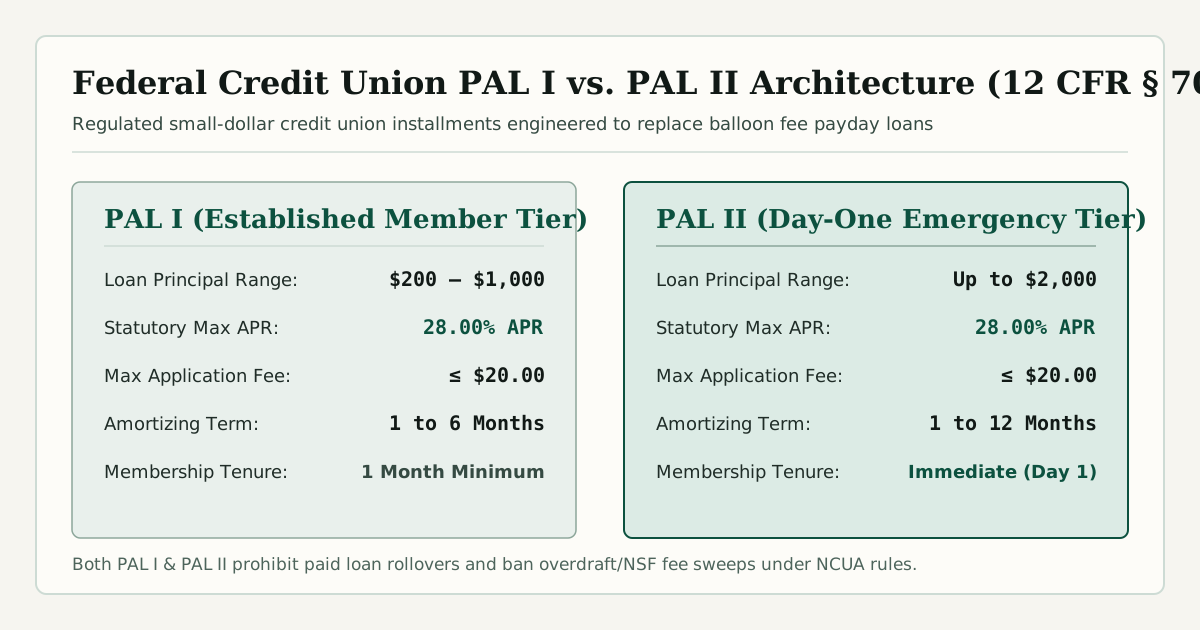
Why the NCUA Created PAL II to Solve the 30-Day Wait Problem
When the NCUA launched the original PAL I program in 2010, federal rules required a borrower to be a member of the credit union for at least one full month before applying, and limited loan amounts between $200 and $1,000 over 1 to 6 months. While PAL I saved millions in fees for existing credit union members, households facing a sudden radiator failure or emergency-room bill on a Wednesday afternoon could not wait thirty days to establish membership.
To close that emergency gap, the NCUA Board enacted PAL II (`12 CFR § 701.21(c)(7)(iv)`), eliminating the minimum membership waiting period altogether. Under PAL II, a participating federal credit union may approve and fund an emergency installment loan of up to $2,000 on the exact same day you join, with up to twelve months to repay.
Statutory Specification Matrix: PAL I vs. PAL II vs. Storefront Payday
Every federally chartered credit union offering PAL loans must comply with hard regulatory guardrails set by federal statute and NCUA Board rulemaking:
| Regulatory Parameter | PAL I (12 CFR § 701.21(c)(7)(iii)) | PAL II (12 CFR § 701.21(c)(7)(iv)) | Typical Online Payday Loan |
|---|---|---|---|
| Loan Principal Limits | $200 minimum to $1,000 maximum | Any amount up to $2,000 maximum | $100 to $1,000 |
| Maximum Interest Rate | 28.00% APR ceiling | 28.00% APR ceiling | 304% to 660% APR (see APR math) |
| Application Fee Cap | Actual cost up to $20.00 max | Actual cost up to $20.00 max | $15 to $30 per $100 borrowed |
| Repayment Structure | 1 to 6 months, fully amortizing | 1 to 12 months, fully amortizing | 14-day single-payment balloon |
| Minimum Membership Wait | At least 1 month prior membership | None — eligible on Day 1 of joining | None |
| Overdraft / NSF Sweep Ban | Permitted per standard share agreement | Overdraft & NSF fees strictly banned | Repeated ACH debit fees common |
| Active Loan Concurrency | 1 active PAL at a time; max 3 in 6 mos | 1 active PAL at a time; max 3 in 6 mos | Multi-lender stacking widespread |
Dollar-for-Dollar Cost Comparison on a $600 Emergency Repair
To see how dramatically amortization and the 28% statutory cap alter household cash flow, compare borrowing $600 for three months (six biweekly paychecks) through a federal credit union PAL II loan versus rolling over a $600 payday advance at $15 per $100 across the same twelve-week window:
- $600 NCUA PAL II Loan (3 Months at 28% APR + $20 Application Fee): You make six manageable biweekly payments of roughly $104.70. Total interest across the entire 90 days is approximately $28.20; even including the maximum $20 application fee, your total cost of credit is $48.20, and after payment six your debt is $0.00.
- $600 Balloon Payday Advance ($90 Fee per 14 Days): Paying $90 every two weeks to roll the loan across five renewals plus final payoff drains $540.00 in finance fees alone ($1,140.00 total withdrawn)—more than eleven times the cost of the credit union loan. Run your own principal in our Interactive True-APR Ledger or review full rate schedules.
How Credit Unions Underwrite PAL Loans Without High FICO Scores
A common misconception keeps many borrowers from applying at a local or community-chartered credit union: the fear of automatic rejection due to a 540–610 credit score or past medical collections. Under NCUA supervisory guidance, federal credit unions offering PAL I and PAL II routinely rely on cash-flow underwriting rather than strict prime credit-bureau cutoffs:
What Loan Officers Verify Instead of Prime Credit Scores
- Verifiable Recurring Income: Two recent paystubs, consistent gig-platform bank deposits, Social Security benefit award letters, VA disability statements, or pension deposits proving steady repayment capacity.
- Payroll Direct Deposit Alignment: Scheduling automatic biweekly or monthly transfers timed to land on your exact direct-deposit morning dramatically lowers default risk and often accelerates approval to within 24 business hours.
- Absence of Active Bankruptcy or Recent Charge-Off at That Institution: Past blemishes on old retail credit cards rarely disqualify a PAL applicant when current checking deposits cover the modest amortizing payment.
How to Qualify for Membership When You Don't Work for a Specific Employer
Every federal credit union has a "field of membership," yet thousands of community-chartered and associational federal credit unions are open to virtually any U.S. resident:
- Geographic Community Charters: If you live, work, worship, or attend school within a county or metropolitan statistical area, every community-chartered federal credit union in that region can enroll you with a government ID and a $5 par-value share deposit.
- Associational & Nonprofit Membership Bridges: Many national federal credit unions partner with consumer education nonprofits or financial literacy foundations—allowing any applicant nationwide to join via a one-time $5 to $10 foundation enrollment during the online application.
- CDFI Credit Unions & Juntos Avanzamos Institutions: Community Development Financial Institution (CDFI) credit unions specialize specifically in small-dollar emergency loans and credit-builder installment products that report positive on-time payment history to Equifax, Experian, and TransUnion—helping you graduate toward sub-15% signature lines over time while staying protected under federal and state rate caps.