
The central hazard of a lump-sum payday cash advance is rarely the first $45 or $60 finance fee in isolation—it is the structural mismatch between a single-payment balloon maturity and an ordinary working household's biweekly cash flow. Longitudinal research published by the Consumer Financial Protection Bureau (CFPB) tracking millions of small-dollar loan sequences found that more than 80% of payday loans are rolled over or followed by another loan within 14 days, and half of all storefront sequences stretch across at least ten consecutive paychecks before the original principal is retired.
Why do disciplined wage earners get caught in multi-month renewal loops? Because a household earning $1,450 net every two weeks with $1,320 in fixed rent, utility, childcare, and grocery commitments only has $130 of true biweekly surplus. Demanding a $460 lump-sum payoff on Friday morning mathematically guarantees a $330 budget hole by Monday afternoon—forcing the borrower either to pay a $60 "interest-only renewal" fee or to pay off the loan at 9:00 AM and re-borrow the exact same $400 principal at 9:15 AM.
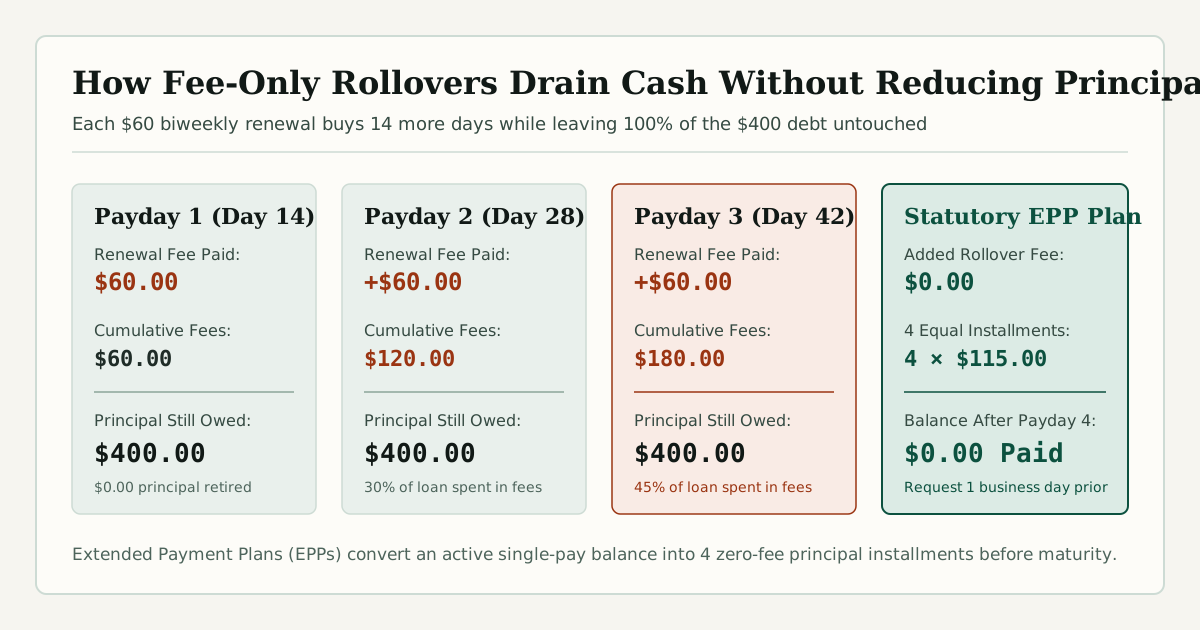
Anatomy of Principal Stagnation Across Four Pay Cycles
In an amortizing installment loan—such as a 28% NCUA PAL II credit union loan—every payment splits between accrued interest and principal reduction, steadily shrinking your balance toward zero. A fee-only payday rollover (or a back-to-back "pay-and-reborrow" transaction engineered to skirt nominal rollover bans) retires $0.00 of principal. Every dollar debited on payday simply purchases another fourteen days on the clock while leaving 100% of the debt intact.
| Biweekly Pay Event ($400 Principal at $15/$100 Fee) | Elapsed Days | Debit Paid This Cycle | Cumulative Fees Spent | Principal Balance Remaining |
|---|---|---|---|---|
| Origination Day (Cash Deposited) | Day 0 | $0.00 | $0.00 | $400.00 |
| Payday 1 — Renewal #1 | Day 14 | $60.00 fee only | $60.00 | $400.00 |
| Payday 2 — Renewal #2 | Day 28 | $60.00 fee only | $120.00 | $400.00 |
| Payday 3 — Renewal #3 | Day 42 | $60.00 fee only | $180.00 | $400.00 |
| Payday 4 — Renewal #4 | Day 56 | $60.00 fee only | $240.00 | $400.00 |
| Payday 5 — Final Lump-Sum Payoff | Day 70 | $460.00 ($400 + $60) | $300.00 | $0.00 |
By Payday 5—barely ten weeks after borrowing $400—the household has surrendered $700.00 in total checking debits ($300 in fees plus $400 principal), surrendering nearly three-quarters of the original advance in pure finance charges. You can model 0 to 4 renewals on any dollar principal using our True-APR & Rollover Calculator.
How Same-Day "Cool-Off" Workarounds Mimic Rollovers
Roughly a dozen states technically prohibit direct rollovers on paper while permitting a lender to issue a brand-new cash advance moments after the prior loan clears—or after a cosmetic 24-hour cooling-off window. From a household cash-flow standpoint, paying off $460 at 8:30 AM on payday and taking a fresh $400 advance at 10:00 AM the next morning is economically identical to a $60 fee-only rollover:
- Your checking account experiences a net -$60.00 cash drain on payday.
- Your debt obligation resets to $460.00 due two weeks later.
- If an automated ACH debit bounces because rent cleared first, your bank may assess a $30 to $35 Non-Sufficient Funds (NSF) fee alongside the lender's returned-item charge, compounding the loss.
Your Statutory Off-Ramp: Extended Payment Plans (EPPs)
If you currently hold an active single-payment payday advance and already know retiring the full balance on Friday will cause your rent or electric payment to bounce, do not wait until the maturity date passes. Sixteen state deferred-deposit statutes—and lenders belonging to the Community Financial Services Association of America (CFSA)—provide a statutory or contractual right to convert an active balloon loan into a no-fee Extended Payment Plan (EPP).
States With Mandatory Statutory Payment Plan Rights
Jurisdictions enforcing statutory repayment off-ramps or grace periods include Washington (RCW 31.45.084, granting 90 to 180 days at zero added fee upon request any time on or before the due date), Idaho (Idaho Code § 28-46-414, four equal installments over at least 60 days with zero additional cost once per 12 months), Indiana (after three consecutive renewals), Utah, Nevada, Wyoming, Michigan, South Carolina, Virginia, and Florida (a 60-day grace period when scheduling an appointment with a state-recognized consumer credit counseling agency). Check your state's exact rule in our State Rate-Cap & EPP Matrix.
Exact Rules for Triggering an Extended Payment Plan
State examiners warn that borrowers most frequently lose their EPP eligibility because of a narrow timing technicality: once a loan enters formal default after the due date, many statutory EPP rights expire. Follow this four-step sequence precisely:
- Act Before Close of Business One Business Day Prior: Request the Extended Payment Plan in writing (and via the online borrower portal if borrowed online) at least 24 to 48 hours before your scheduled due date—never the morning the ACH debit is already in flight.
- Use Exact Statutory Terminology: State clearly: "I am exercising my statutory right to convert Loan #[Number] into a no-cost Extended Payment Plan prior to maturity." Decline any counter-offer to "refinance" into a high-APR multi-year installment loan carrying new origination fees.
- Sign the Written EPP Amendment Promptly: Most state laws require you to sign the modified 4-installment schedule (either electronically or at the branch) by close of business on the original maturity date.
- Save Your Timestamped Confirmation: Screenshot or download the signed four-payment schedule showing your active balance divided into four equal pay-date installments (for example,
$460 ÷ 4 = $115.00 per paycheck) with $0.00 in added finance charges.
Replacing Repeat Cash Advances With Permanent Liquidity Buffers
Once you exit a single-pay rollover sequence via an Extended Payment Plan, protect your next emergency from triggering another balloon contract:
- Open a $5 Share Account at a PAL-Participating Federal Credit Union Today: Even if you do not need credit this month, establishing membership makes you eligible for both PAL I (after 30 days) and PAL II (day one) capped at 28.00% APR (view full PAL I vs. PAL II schedule).
- Negotiate Source-Bill Forbearance First: Electric, gas, municipal water, and hospital billing desks routinely split a $350 overdue balance across three monthly statements at 0% interest when contacted before disconnection.
- Audit State Licensing on Unsolicited Online Portals: If an unlicensed offshore or nominal tribal website demands uncapped renewals in violation of your state 36% APR cap or usury statute, consult your state Attorney General's Consumer Protection Division before sending additional renewal fees.