
Unlike national credit card interest rates—which national banks export across state lines from states like Delaware or South Dakota under the Supreme Court's 1978 Marquette National Bank doctrine—non-bank online payday and small-dollar installment lenders are governed primarily by state consumer finance and usury statutes in the state where the borrower physically resides. That single legal principle creates one of the widest geographic price divides in American household finance: the exact same $500 online loan request can be capped at 36% all-in APR in Illinois or Colorado, completely void and unenforceable in New York or North Carolina, capped at a regulated flat fee in Washington or Florida, or priced above 600% APR in an uncapped jurisdiction.
The Federal Gold Standard: The 36% Military Lending Act (MLA) Cap
Modern state small-dollar reform statutes borrow their mathematical backbone directly from federal law: the Military Lending Act (`10 U.S.C. § 987`), implemented by Department of Defense regulations at 32 CFR Part 232. Enacted after Pentagon readiness audits revealed that triple-digit payday loans clustered outside military bases were stripping security clearances from enlisted personnel, the MLA establishes an ironclad 36.00% Military Annual Percentage Rate (MAPR) ceiling for active-duty service members, Guard/Reserve members on active orders, and their covered dependents nationwide.
Crucially, the MLA invented the "all-in" MAPR calculation. Standard Truth in Lending APR rules historically allowed certain lenders to exclude optional credit insurance premiums, ancillary club memberships, or application fees from the headline APR. Under the MLA—and newer state statutes modeled directly on it—every credit-related fee, broker commission, credit insurance add-on, and participation charge must be folded into the 36% ceiling, and lenders are barred from requiring borrowers to waive legal recourse or submit to mandatory allotment/check holds.
Comparing the Four State Statutory Lending Postures
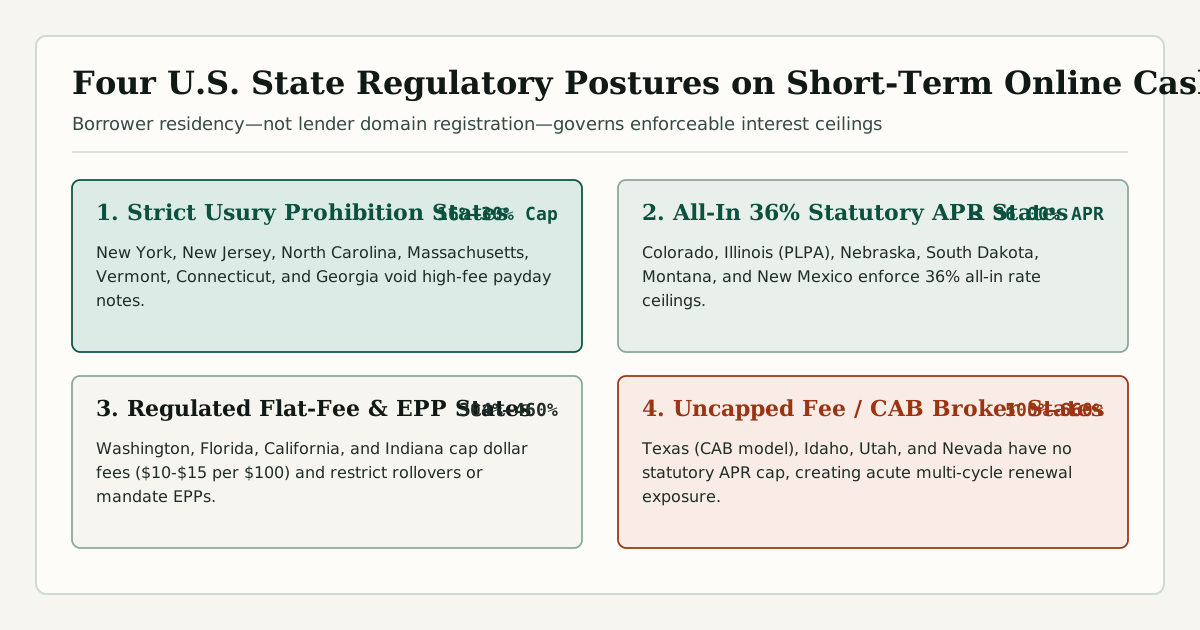
Roughly twenty-one states plus the District of Columbia now enforce either traditional civil/criminal usury bans or explicit ~36% small-dollar APR caps, while remaining states split between regulated flat-fee deferred-deposit statutes and uncapped Credit Access Business or installment loopholes (search specific jurisdictions on our State Rate-Cap table):
| State Regulatory Category | Representative Jurisdictions | Enforceable Cost Limit | Key Consumer Protection Mechanism |
|---|---|---|---|
| Strict Civil / Criminal Usury Ban | NY, NJ, NC, MA, CT, VT, PA, GA, AR, MD | 6% to 30% statutory ceiling | Unlicensed high-rate online payday notes are void as to principal, interest, or both |
| Voter / Statutory 36% All-In Cap | IL, CO, NE, SD, MT, NM, MN, DC | ≤ 36.00% all-in APR / MAPR | Closes ancillary fee, broker, and insurance add-on loopholes; mandates installments |
| Regulated Flat-Fee + EPP Off-Ramp | WA, FL, CA, IN, VA, MI, SC | $10–$15 per $100 (304%–460% APR) | Statewide borrower database caps loan count; statutory Extended Payment Plans |
| Uncapped Fee / CAB Broker Model | TX, ID, UT, NV, WI, MO | No statutory APR ceiling (500%+ common) | Relies primarily on Truth-in-Lending disclosure or municipal city ordinances |
How All-In State Statutes Closed Fee-Splitting Loopholes
Early state rate-cap laws sometimes capped nominal "interest" at 36% without capping "origination," "credit investigation," or "monthly maintenance" fees—allowing lenders to advertise 24% interest while charging a $150 biweekly brokerage fee. Recent state laws closed those gaps decisively:
Illinois Predatory Loan Prevention Act (815 ILCS 123)
Enacted in 2021, the Illinois PLPA explicitly incorporates the federal Military Lending Act's 36% all-in MAPR methodology for every civilian resident of Illinois on consumer loans below $40,000, adds strict anti-evasion language covering bank-partnership fronts, and declares any loan exceeding 36% MAPR null and void so no entity has the right to collect principal, interest, or charges.
Colorado Proposition 111 & True-Lender Enforcement
Colorado voters approved Proposition 111 by more than 77%, capping payday/small-dollar loans at 36% APR with zero origination fees permitted during initial balloon windows, minimum six-month installment terms, and no prepayment penalties. Colorado further exercised its federal Depository Institutions Deregulation and Monetary Control Act (DIDMCA) opt-out rights to curb out-of-state "rent-a-bank" rate exportation onto local residents.
Three Red Flags of Unlicensed Rate-Cap Evasion Online
Even if you live in a 36%-cap or usury-ban state such as New York, Illinois, Colorado, or North Carolina, aggressive search ads still promote "instant no-credit-check $500 deposits." Before entering personal information on an unfamiliar lending site, watch for three legal red flags:
- Missing State Regulator License Number in the Website Footer: Legitimate small-dollar lenders display their state Department of Financial Protection, Office of Consumer Credit Commissioner, or NMLS license number prominently and can be verified on
nmlsconsumeraccess.orgin thirty seconds. - Choice-of-Law Clauses Waiving State Consumer Law: Contracts claiming that your loan is governed exclusively by offshore foreign law (such as Belize, Nevis, or Malta) or purporting to strip all federal Truth in Lending and state usury protections are routinely challenged by state Attorneys General and federal courts when the borrower applied from home in the United States.
- Broker "Lead Marketplace" Disclaimers Without Lender Identity: Lead generators are not lenders; once you submit bank routing numbers into an anonymous ping tree, dozens of unregulated data buyers may purchase your profile simultaneously.
Safer Regulated Paths Regardless of Which State You Live In
Even if you reside in a state without a 36% statutory cap—such as Texas, Utah, Nevada, or Idaho—you can still enforce your own household rate ceiling by choosing federally regulated institutions:
- Federal Credit Union PAL I & PAL II (28% Nationwide Cap): Because federal credit unions operate under NCUA rules (`12 CFR § 701.21`), the 28% APR ceiling and $20 max application fee apply equally whether you live in Houston, Boise, or Chicago (read our PAL I & PAL II eligibility guide or check full statutory tables).
- Active-Duty Military Verification: Service members and spouses can verify covered MLA status at
mla.dmdc.osd.miland seek free legal review from base Judge Advocate General (JAG) legal assistance offices before signing any emergency credit note.